Thumbnail Slider

Why So Many Homeowners Are Downsizing Right Now

Why So Many Homeowners Are Downsizing Right Now

For a growing number of homeowners, retirement isn’t some distant idea anymore. It’s starting to feel very real.

According to Realtor.com and the Census, nearly 12,000 people will turn 65 every day for the next two years. And the latest data shows as many as 15% of those older Americans are planning to retire in 2026. And another 23% will do the same in 2027.

If you’re considering retiring soon too, here’s what you should be thinking about.

Why Downsize?

Now's the perfect time to reflect on what you want your life to look like in retirement. Because even though your finances will be going through a big change, you don’t necessarily want to feel like you’re living with less.

But odds are, what you do want is for life to feel easier.
Easier to enjoy.
Easier to manage.
Easier to maintain day-to-day.

The Top Reasons People Over 60 Move
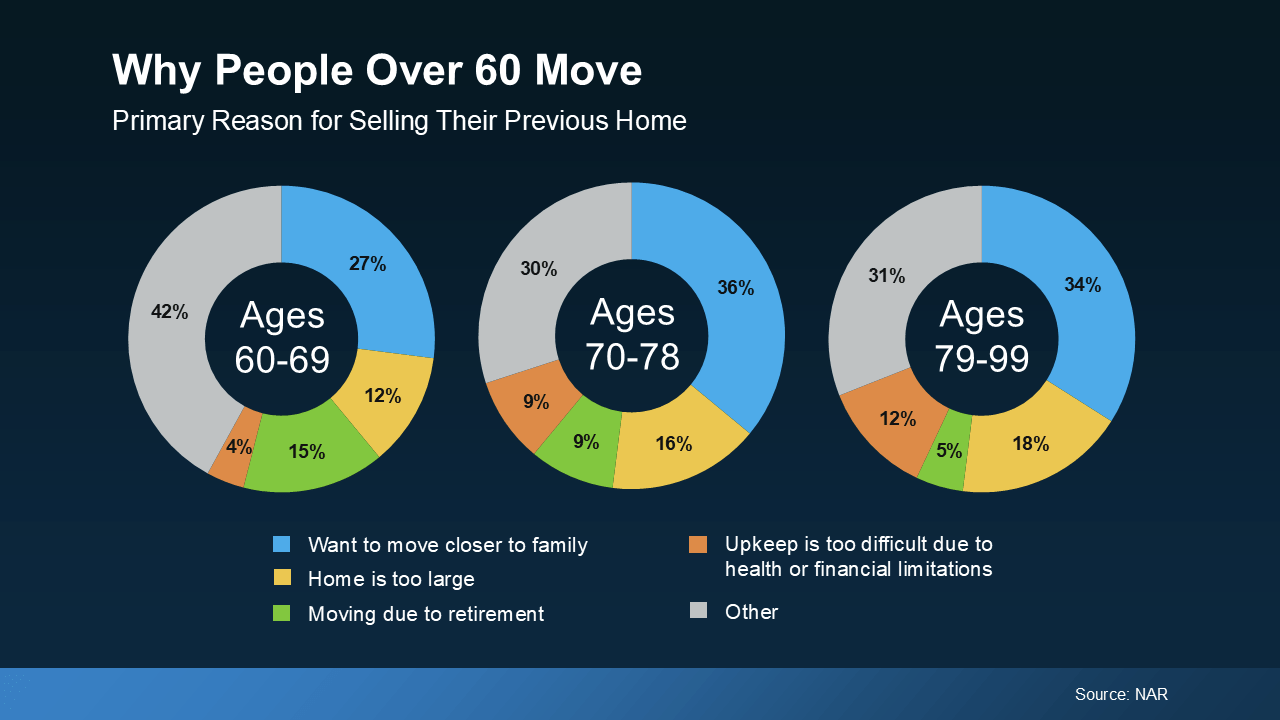
You can see these benefits show up in the data when you look at why people over 60 are moving. The National Association of Realtors (NAR) finds the top 4 reasons aren’t about timing the market or chasing top dollar. They’re about lifestyle:

1. Being closer to children, grandchildren, or long-time friends so it’s easier to spend more time with the people who matter most
2. Wanting a smaller, more functional home with fewer stairs and easier upkeep
3. Retiring and no longer needing to live near the office, so it’s easier to move wherever you want
4. Opting for something smaller to reduce monthly expenses tied to utilities, insurance, and maintenance


No matter the reason, the theme is the same: downsizing isn’t about giving something up. It’s about gaining control and choosing simplicity. And it brings peace of mind to know your home fits the years ahead, not the years behind.

And the best part? It’s more financially feasible now than many homeowners would expect.

The #1 Thing Helping So Many Homeowners Downsize

Here’s the part that makes it possible. Thanks to how much home values have grown over the years, many longtime homeowners are realizing they’re in a stronger position than they thought to make that move.

According to Cotality, the average homeowner today has about $299,000 in home equity. And for older Americans, that number is often even higher – simply because they’ve lived in their homes longer.

When you stay in one place for years (or even decades), two things happen at the same time:

Your home value has time to grow.

Your mortgage balance shrinks or disappears altogether.

That combination creates more options than you’d expect, even in today’s market.

So, whether you just retired, or you're about to, it's not too soon to start thinking about what comes next. Sure, it can be hard to leave the house you made so many years of memories in, but maybe it’s time to close one chapter to open a new one that’s just as exciting. 

Bottom Line
Downsizing is about setting yourself up for what comes next – on your terms.

If retirement is on the horizon and you’ve started wondering what your current house (and your equity) could make possible, the first step isn’t selling. It’s understanding your options.
Let’s talk. A simple, no-pressure conversation can help you see what downsizing might look like – and whether it makes sense for you. 

To view data for every Essex County town,

Essex County Housing Report 3-18-2025

Essex County Housing Report February 2025, 3/18/2025

Bottom Line:
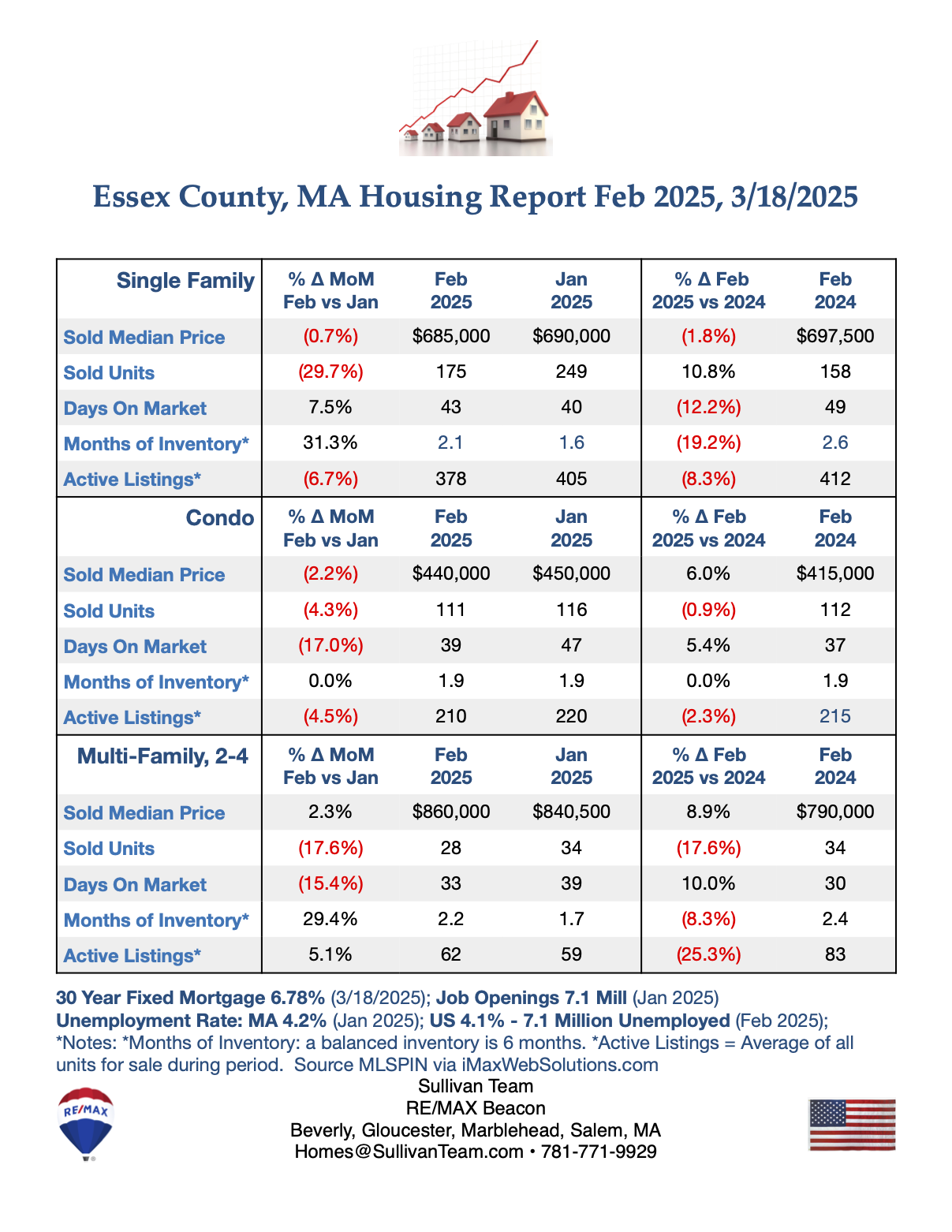
Inflation, came in lower than expected. Feb CPI rose +0.2% which was a substantial drop from +0.5% in January. Core Inflation, CPI less food and energy, rose +0.2% in February down 50% from +0.4% in January. 12 month CPI was +2.8% and Core Inflation was +3.1%, still above the Federal Reserve’s target of 2%. 30 year Mortgage rate improved slightly and fell from the 7.1% level in January to a 6.8% level in February. Today’s mortgage rate is 6.78% (Mortgage News Daily).

Winter Seasonality and a bitter cold February suppressed single family and condo unit sales and sold prices and the number of active listings also fell from Jan 2025. 2-4 Family sales also fell double digit but prices edged up. Months of Inventory remains near record low levels indicating a shortage of housing units for sale: Inventory is: Single Family 2.1 months; Condos 1.9 months and 2-4 Families 2.2 Months. A balanced market is 6 months of inventory. Year over Year, February prices were mixed: Single Families prices fell -1.8% but Condos rose + 6.0% and 2-4 Unit Multi-Families rose +8.9%.

 To view data for every Essex County town,

Essex County Housing Report 11/15/2024

Essex County Housing Report 11/15/2024


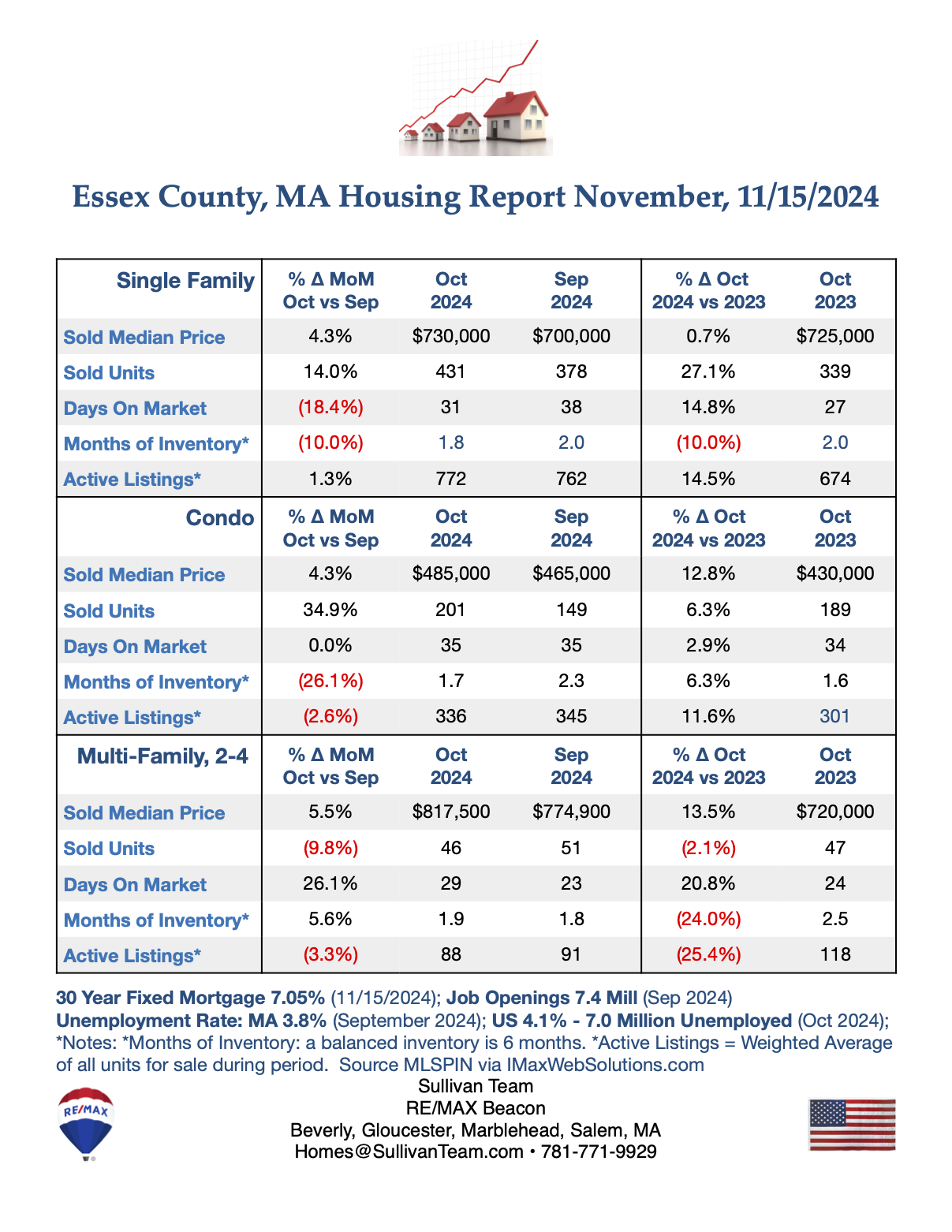
30 Year Mortgage Rates are 7.05% per Mortgage News Daily.


Housing Inventory is still very low: 
Single Family 1.8 months, Condos 1.7 months. A balanced

market is 6 months of inventory.

Inflation running hotter than expected which impacts Future Federal Reserve Rate Cuts:

October 2024 Consumer Price Index Report (CPI), 11-13-2024:
12 month CPI inflation rose 2.6% and Core Inflation (all items less food and energy) rose 3.3%. The Federal Reserve’s target is 2%. October 2024 Monthly CPI rose +0.2% and Monthly Core Inflation rose +0.3%.

Single Family & Condo Median Prices and Units Sold Rose Month over Month and Year over Year as Inventory remained very low.


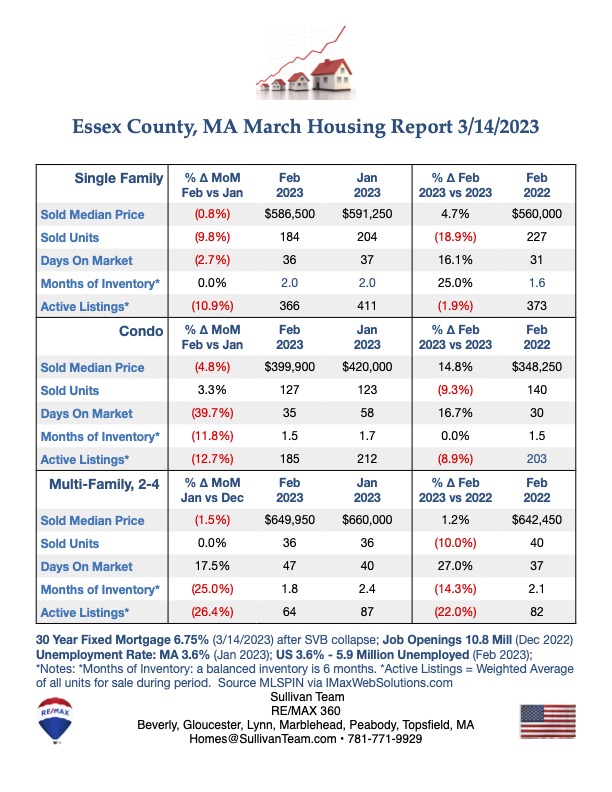
Essex County March Housing Report 3/14/2023

Between Friday, March 10 and Monday, March 13, the second and third largest US Bank failures occurred, #2 Silicon Valley Bank (SVB) and #3 Signature Bank, arising from the Fed’s rapid rise in interest rates which dramatically reduced the value of all banks long term investment bonds / notes. These bank failures resulted in a flight to safety by investors to US Treasuries and drove down their interest rates. The odd beneficiary was the 30 year fixed rate mortgage which fell from 7% on Friday to 6.57% on Monday. Rates rose Tuesday, March,14, to 6.75% as the banking crises eased ( Mortgagee rates per Mortgage News Daily).

Federal Reserve conundrum: Keep fighting inflation by increasing rates and possibly generating more bank failures or backing off on their rate increases for now. The Consumer Price Index today was up 0.5% in February and 6% for the year. The Federal Reserve’s goal of 2% inflation.

Today’s Bottom Line for Singles, Condos and Multies:

Units Sales and Active Listings continue to fall both year over year and month over month as mortgage rates rise. Prices softened from Jan to Feb.


Housing Market Forecast 2023

What To Expect From the Housing Market in 2023


The 2022 housing market has been defined by two key things: inflation and rapidly rising mortgage rates. And in many ways, it's put the market into a reset position.

As the Federal Reserve (the Fed) made moves this year to try to lower inflation, mortgage rates more than doubled – something that’s never happened before in a calendar year. This had a cascading impact on buyer activity, the balance between supply and demand, and ultimately home prices. And as all those things changed, some buyers and sellers put their plans on hold and decided to wait until the market felt a bit more predictable.

But what does that mean for next year? What everyone really wants is more stability in the market in 2023. For that to happen we’ll need to see the Fed bring inflation down even more and keep it there. Here’s what housing market experts say we can expect next year.

What’s Ahead for Mortgage Rates in 2023?

Moving forward, experts agree it’s still going to be all about inflation. If inflation is high, mortgage rates will be as well. But if inflation continues to fall, mortgage rates will likely respond. While there may be early signs inflation is easing as we round out this year, we’re not out of the woods just yet. Inflation is still something to watch in 2023.

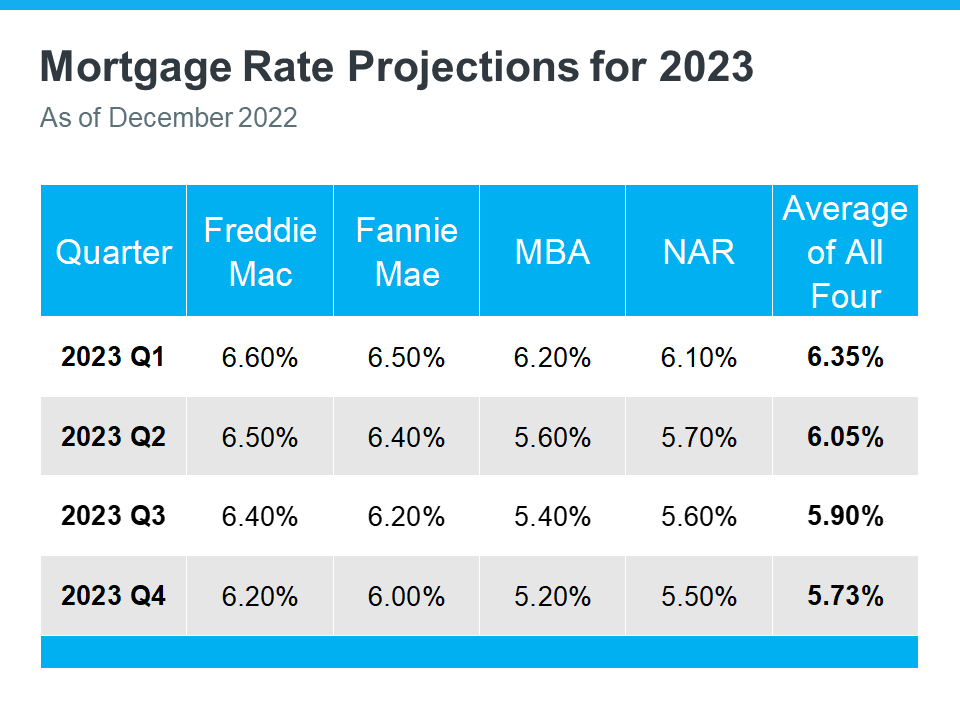
Right now, experts are factoring all of this into their mortgage rate forecasts for next year. And if we average those forecasts together, experts say we can expect rates to stabilize a bit more in 2023. Whether that’s between 5.5% and 6.5%, it’s hard for experts to say exactly where they’ll land. But based on the average of their projections, a more predictable rate is likely ahead (see chart below):

What To Expect from the Housing Market in 2023 | MyKCM

That means, we’ll start the year out about where we are right now. But we could see rates tick down if inflation continues to drop. As Greg McBride, Chief Financial Analyst at Bankrateexplains:

“. . . mortgage rates could pull back meaningfully next year if inflation pressures ease.

In the meantime, expect some volatility as rates will likely fluctuate in the weeks ahead. If we see inflation come back under control, that would be good news for the housing market.

What Will Happen to Home Prices Next Year?

Homes prices will always be defined by supply and demand. The more buyers and fewer homes there are on the market, the more home prices will rise. And that’s exactly what we saw during the pandemic.

But this year, things changed. We’ve seen home prices moderate and housing supply grow as buyer demand pulled back due to higher mortgage rates. The level of moderation has varied by local area – with the biggest changes happening in overheated markets. But do experts think that will continue?

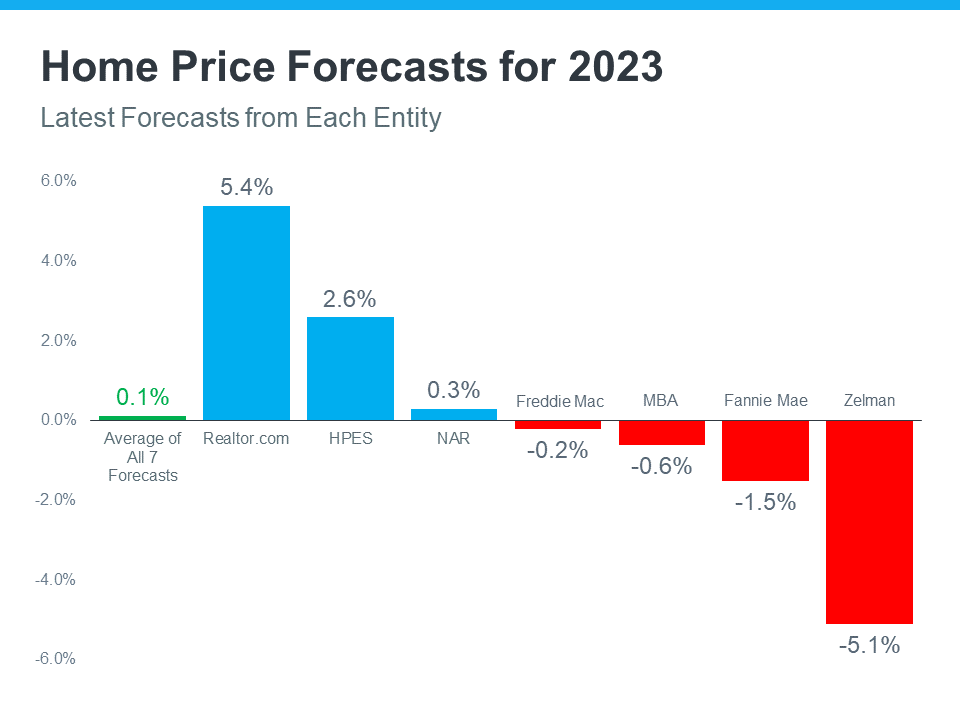
The graph below shows the latest home price forecasts for 2023. As the different colored bars indicate, some experts are saying home prices will appreciate next year, and others are saying home prices will come down. But again, if we take the average of all the forecasts (shown in green), we can get a feel for what 2023 may hold.

What To Expect from the Housing Market in 2023 | MyKCM

The truth is probably somewhere in the middle. That means nationally, we’ll likely see relatively flat or neutral appreciation in 2023. As Lawrence Yun, Chief Economist at the National Association of Realtors (NAR), says:

After a big boom over the past two years, there will essentially be no change nationally . . . Half of the country may experience small price gains, while the other half may see slight price declines.”

Bottom Line

The 2023 housing market is going to be defined by mortgage rates, and rates will be determined by what happens with inflation. The best way to keep a pulse on what experts are projecting for next year is to lean on a trusted real estate advisor. Let’s connect.

Essex County Housing Report December 14, 2022

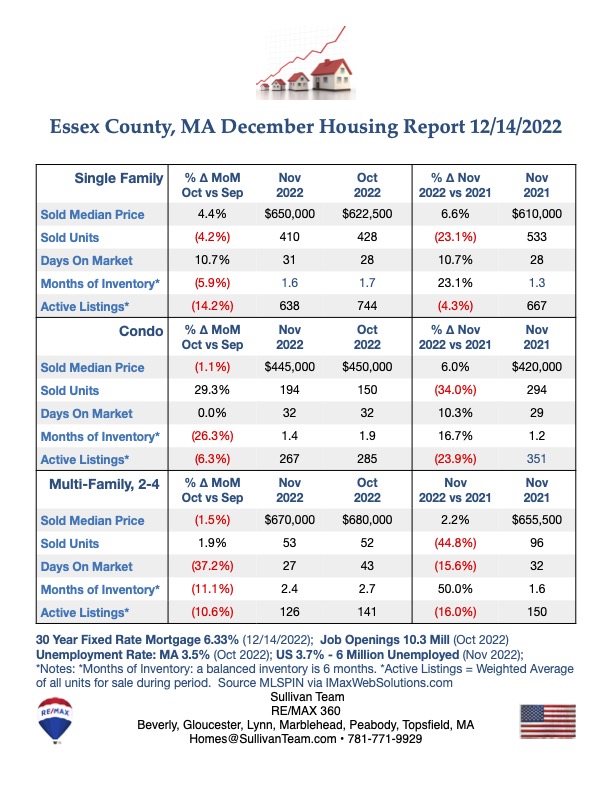
Essex County December Housing Report 12/14/2022

Inflation is slowing, but is way above the Federal Reserve’s target of 2%.  
November CPI (Consumer Price Index) fell to 7.1% from 7.7% in October.
November PPI (Producer Price Index) fell to 7.4% from 8.1% in October. PPI measures wholesale Prices
To fight inflation, the Federal Reserve continues to raise interest rates and sell off their Balance Sheet Assets to tighten credit (Quantitive Tightening).  
Federal Funds Rate increased +0.5% to 4.25% - 4.5% 
Mortgage Rates are trending down; Conforming 30 Year Fixed now 6.33%.

Bottom Line:
Housing Listing and Sales activity continues to moderate as the Fed fights inflation.
Year over Year price increases are slowing, +6.3%, Units Sales fell -26%, Active Listings fell -16%.  Months of Inventory rose +21% as Unit Sales fell more the Active Listings.  

Month Over Month, November 2022 vs October 2022

  • Median Sold Prices:
    Single Families +4.4%;  Condos -1.1%;  Multi-Families  -1.5%
  • Unit Sales:
    Single Families -4.2%, Condos +29.3%, Multi-Families +1.9%
  • Active Listings:
    Single Families -14.2%, Condos -6.3%, Multi-Families -10.6% 
  • Current Months of Inventory:
    Single Families 1.6, Condos 1.4, Multi-Families 2.4

Year Over Year, November 2022 vs November 2021

  • Median Sold Prices: 
    Single Families +6.6%; Condos +6.0%;  Multi-Families +2.2% 
  • Unit Sales:
    Single Families -23.1% , Condos -34.0%, Multi-Families -44.8%.
  • Active Listings:
    Single Families -4.3%; Condos -23.9%; Multi-Families -16.0% 
  • Change in Months of Inventory:
    Single Families +23.1%, Condos  16.7%, Multi-Families +50.0%.

    Terry Sullivan

Hedge Against Inflation With These 3 Real Estate Investment Types


Hedge Against Inflation With These 3 Real Estate Investment Types

 The annual inflation rate in the United States is currently around 7.5%—the highest it has been since 1982.1 It doesn’t matter if you’re a cashier, lawyer, plumber, or retiree; if you spend U.S. dollars, inflation impacts you. 

Economists expect the effects of inflation, like a higher cost of goods, to continue.2 Luckily, an investment in real estate can ease some of the financial strain. 

Here’s what you need to know about inflation, how it impacts you, and how an investment in real estate can help.

WHAT IS INFLATION AND HOW DOES IT IMPACT ME?

Inflation is a decline in the value of money. When the rate of inflation rises, prices for goods and services go up. Therefore, a dollar buys you a little bit less with every passing day.

The consumer price index, or CPI, is a standard measure of inflation. Based on the latest CPI data, prices increased 7.5% from January 2021 to January 2022.1 A little bit of inflation is considered healthy for the economy, but 7.5% in a single year is high. 

How does inflation affect your life? Here are a few of the negative impacts

  • Decreased Purchasing Power

We touched on this already, but as prices rise, your dollar won’t stretch as far as it used to. That means you’ll be able to purchase fewer goods and services with a limited budget.

  • Increased Borrowing Costs

In an effort to curb inflation, the Federal Reserve is expected to raise the federal funds rate. Therefore, consumers are likely to pay a higher interest rate on new mortgages, car loans, and variable-rate credit cards.3

  • Lower Standard of Living 

Wage growth tends to lag behind price increases. According to Moody Analytics, when adjusted for inflation, average weekly earnings in January were down 3.1% from a year earlier.4 As such, life is becoming less affordable for everyone. Inflation can force those on a fixed income, like retirees, to make lifestyle changes and prioritize essentials.

  • Eroded Savings 

If you store all your savings in a bank account, inflation is even more damaging. As of February 2022, the national average interest rate for a savings account is 0.06%, not nearly enough to keep up with inflation. And economists don’t expect that rate to go much higher.3

One of the best ways to mitigate these effects is to find a place to invest your money other than the bank. Even though interest rates are expected to rise, they’re unlikely to get high enough to beat inflation. If you hoard cash, the value of your money will decrease every year and more rapidly in years with elevated inflation.

REAL ESTATE: A PROVEN HEDGE AGAINST INFLATION

So where is a good place to invest your money to protect (hedge) against the impacts of inflation? There are several investment vehicles that financial advisors traditionally recommend, including:

  • Stocks
    Some people invest in stocks as their primary inflation hedge. However, the stock market can become volatile during inflationary times, as we’ve seen in recent months.5
  • Commodities
    Commodities are tangible assets, like oil, livestock, and minerals. The theory is that the price of commodities should climb alongside inflation. But the classic choice–gold–hasn’t risen consistently during periods of inflation since the 1970s, according to data from Morningstar Direct.6
  • Inflation-Indexed Bonds
    Treasury inflation-protected securities, or TIPS, are U.S. government-issued bonds that are indexed to the inflation rate. Bonds are considered low risk, but the returns they offer are generally low, as well.7
  • Real Estate
    Real estate prices across the board tend to rise along with inflation and often rise faster than inflation.That’s one of the reasons demand for real estate is soaring right now.9

 We believe real estate is the best hedge against inflation. Owning real estate does more than protect your wealth—it can actually make you money. For example, home prices rose nearly 17% from 2020 to 2021, 10% ahead of the 7% inflation that occurred in the same timeframe.10

 Plus, certain types of real estate investments can help you generate a stream of passive income. In the past year, property owners didn’t just avoid the erosion of purchasing power caused by inflation; they got ahead. 

TYPES OF REAL ESTATE INVESTMENTS

Though there are myriad ways to invest in real estate, there are three basic investment types that we recommend for beginner and intermediate investors. Remember that we can help you determine which options are best for your financial goals and budget. 

  • Primary Residence

If you own your home, you’re already ahead. The advantages of homeownership become even more apparent in inflationary times. As inflation raises prices throughout the economy, the value of your home is likely to go up concurrently. At the same time, you’ve locked in a set mortgage payment for the next 30 years, so you’ll be immune to rising rental costs.

If you don’t already own your primary residence, homeownership is a worthwhile goal to pursue.

Though the task of saving enough for a down payment may seem daunting, there are several strategies that can make homeownership easier to achieve. If you’re not sure how to get started with the home buying process, contact us. Our team can help you find the strategy and property that fits your needs and budget.

Whether you already own a primary residence or are still renting, now is a good time to also start thinking about an investment property. The types of investment properties you’ll buy as a solo investor generally fall into two categories: long-term rentals and short-term rentals. 

  • Long-Term (Traditional) Rentals 

A long-term or traditional rental is a dwelling that’s leased out for an extended period. An example of this is a single-family home where a tenant signs a one-year lease and brings all their own furniture.

Long-term rentals are a form of housing. For most tenants, the rental serves as their primary residence, which means it’s a necessary expense. This unique quality of long-term rentals can help to provide stable returns in uncertain times, especially when we have high inflation. 

To invest in a long-term rental, you’ll need to budget for maintenance, repairs, property taxes, and insurance. You’ll also need to have a plan for managing the property. But a well-chosen investment property should pay for itself through rental income, and you’ll benefit from appreciation as the property rises in value.

We can help you find an ideal long-term rental property to suit your budget and investment goals. Reach out to talk about your needs and our local market opportunities.

  • Short-Term (Vacation) Rentals

Short-term or vacation rentals function more like hotels in that they offer temporary accommodations. A short-term rental is defined as a residential dwelling that is rented for 30 days or less. The furniture and other amenities are provided by the property owner, and today many short-term rentals are listed on websites like Airbnb and Vrbo.

A short-term rental can potentially earn you a higher return than a long-term rental, but this comes at the cost of daily, hands-on management. With a short-term rental, you’re not just entering the real estate business; you’re entering the hospitality business, too. 

Done right, short-term rentals can be both a hedge against inflation and a profitable source of income. As a bonus, when the home isn’t being rented you have an affordable vacation spot for yourself and your family!

Contact us today if you’re interested in exploring options in either the long-term or short-term rental market. Mortgage rates are expected to rise, so you’ll want to act fast to maximize your investment return.

WE’RE INVESTED IN HELPING YOU

Inflation is a fact of life in the U.S. economy. Luckily, you can prepare for inflation with a carefully managed investment portfolio that includes real estate. Owning a primary residence or investing in a short-term or long-term rental will help you both mitigate the effects of inflation and grow your net worth, which makes it a strategic move in our current financial environment.

If you’re ready to invest in real estate to build wealth and protect yourself from rising inflation, contact us. Our team can help you find a primary residence or investment property that meets your financial goals. 

The above references an opinion and is for informational purposes only.  It is not intended to be financial advice. Consult the appropriate professionals for advice regarding your individual needs.

Sources: 

  1. Bloomberg -
    https://www.bloomberg.com/news/articles/2022-02-10/u-s-inflation-charges-higher-with-larger-than-forecast-gain
  2. CNN -
    https://www.cnn.com/2022/01/01/economy/inflation-prices-2022-preview/index.html
  3. CNBC -
    https://www.cnbc.com/2022/01/26/the-fed-sets-the-stage-for-a-rate-hike-heres-what-that-means-for-you.html
  4. Reuters -
    https://www.reuters.com/business/us-consumer-prices-rise-strongly-january-weekly-jobless-claims-fall-2022-02-10/
  5. NBC News -
    https://www.nbcnews.com/business/markets/market-slide-dow-falls-700-points-sp-enters-correction-territory-rcna13304
  6. CNBC -
    https://www.cnbc.com/2021/12/20/gold-is-losing-its-status-as-an-inflation-hedge-two-traders-warn.html
  7. Morningstar -
    https://www.morningstar.com/articles/1079158/why-are-inflation-protected-bond-funds-losing-money
  8. The Washington Post -
    https://www.washingtonpost.com/business/2022/01/04/heres-how-inflation-could-affect-your-next-real-estate-move/
  9. Bloomberg - 
    https://www.bloomberg.com/news/articles/2022-01-24/is-real-estate-a-good-investment-hedge-against-inflation-what-the-experts-say
  10. CNN -
    https://www.cnn.com/2022/01/20/homes/us-nar-home-sales-december-and-2021/index.html

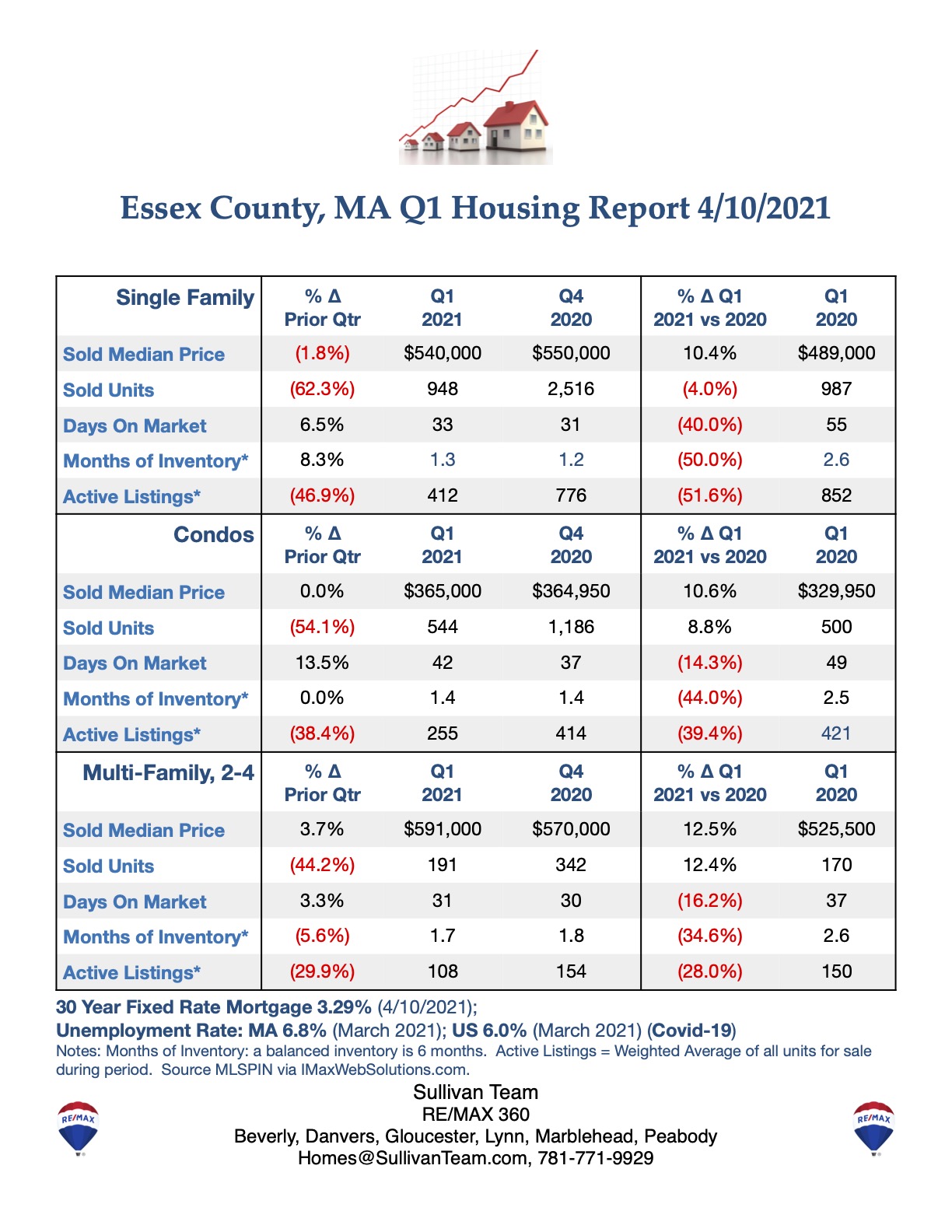
Essex County Q1, 2021 Housing Report

 Essex County Q1, 2021 Housing Report 4/10/2021 - Covid 19

 Quarter 1, 2021 vs Q4, 2020: Sold Prices were soft and Sold Units and Active Listings plunged. 

Year Over Year, Inventory fell to record low levels but prices up strongly.

Quarter 1, 2021 vs Quarter 4, 2020 

  • Median Sales Prices rose only for Multies:
    Single Families -1.8%;  Condos +0.0%;  Multi-Families +3.7%
  • Unit Sales Plunged for Singles, Condos and Multis:
    Single Families -62.3%, Condos -54.1%, Multi-Families -44.2%.
  • Active Listings Plunged to record lows:
    Single Families -46.9%, Condos -38.4%, Multi-Families  -29.9% 

 Year Over Year, Q1 2021 vs Q4 2020

  • Median Sales Prices Up Double Digit: 
    Single Families +10.4%; Condos +10.6%;  Multi-Families +12.5% 
  • Unit Sales Mixed:
    Single Families -4.0% , Condos +8.8%, Multi-Families +12.4%.
  • Number of Active Listings Plunged to Record Lows:
    Single Families -51.6%; Condos -39.4%; Multi-Families -28.0% 


Could Rising Home Prices Impact Your Net Worth?


Could Rising Home Prices Impact Your Net Worth?

Learn how to determine your current net worth and how an investment in real estate can help improve your bottom line.

Among its many impacts, COVID-19 has had a pronounced effect on the housing market. Low home inventory and high buyer demand have driven home prices to an all-time high.1 This has given an unexpected financial boost to many homeowners during a challenging time. However, for some renters, rising home prices are making dreams of homeownership feel further out of reach.

If you’re a homeowner, it’s important for you to understand how your home’s value contributes to your overall net worth. If you’re a renter, now is the time for you to figure out how homeownership fits into your short-term goals and your long-term financial future. An investment in real estate can help you grow your net worth, build wealth over time, and gain a foothold in the housing market to keep pace with rising prices.

What is net worth?

Net worth is the net balance of your total assets minus your total liabilities. Or, basically, it is what you own minus what you owe.2

Assets include the cash you have on hand in your checking and savings accounts, investment account balances, salable items like jewelry or a car and, of course, your home and any other real estate you own. 

Liabilities include your total debt obligations like car loans, credit card debt, the amount you owe on your mortgage, and student loans. In addition, liabilities would include any other payment obligations you have, like outstanding bills and taxes.

How do I calculate my net worth?

To calculate your net worth, you’ll want to add up all of your assets and all of your liabilities. Then subtract your total liabilities from your total assets. The balance represents your current net worth. 


Total Assets – Total Liabilities = Net Worth


Ready to calculate your net worth? Contact us to request an easy-to-use worksheet and a free assessment of your home’s current market value!

Keep in mind that your net worth is a snapshot of your financial position at a single point in time. Your assets and liabilities will fluctuate over both the short term and long term. For example, if you take out a loan to buy a car, you decrease your liability with each payment. Of course, the value of your asset (the car) will depreciate over time, as well. An asset that is invested in stocks or bonds can be even less predictable, as it’s subject to daily fluctuations in the market.

As a homeowner, you enjoy significant stability through your monthly real estate investment, also known as your home mortgage payment. While the actual value of your home can fluctuate depending on market conditions, your mortgage payment will decrease your liability each month. And unlike a vehicle purchase, the value of your home is likely to appreciate over time, which can help to grow your net worth. Right now, your asset may be worth significantly more than it was this time last year.3

If you’re a homeowner, contact us for an estimate of your home’s market value so that you can factor it into your net worth calculation. If you’re not a current homeowner, let’s talk about how homes in our area have appreciated over the last several years. That way, you can get an idea of how a home purchase could positively affect your net worth.

How can real estate increase my net worth?

When you put your real estate dollars to work, it’s possible to grow your net worth, generate cash flow, and even fund your retirement. We can help you realize the possibilities and maximize the return on your investment.

Property Appreciation

Generally, property appreciates in one of two ways: either through changes to the overall market or through value-added modifications to the property itself.

  1. Rising prices

This type of property appreciation is the one that many homeowners are enjoying right now. Buyer demand is at an all-time high due to a combination of record-low interest rates and limited housing inventory.At other times, rising home prices have been attributed to different factors. Certain local conditions—like a new commercial development, influx of jobs, or infrastructure project—can encourage rapid growth in a community or region and a corresponding rise in home values. Historically, home prices have been shown to experience an upward trend punctuated by intermittent booms and corrections.5

  1. Strategic home improvements

Well-planned and executed home improvements can also impact a home’s value and increase homeowner equity at the same time. The type of home improvement should be appropriate for the home and in tune with the desires of local buyers.

For example, a tasteful exterior remodel that is in keeping with the preferences of local home buyers is likely to add significant value to a home, while remodeling the home to look like the Taj Mahal or a favorite theme park attraction will not. A modern kitchen remodel tends to add value, while a kitchen remodel that is overly expensive or personalized may not provide an adequate return on investment.

  Investment Property

You may be used to thinking of investments primarily in terms of stocks and bonds. However, the purchase of a real estate investment property offers the opportunity to increase your net worth both upon purchase and year after year through appreciation. In addition, rental payments can have a positive impact on your monthly income and cash flow. If you currently have significant equity in your home, let's talk about how you could put that equity to work by funding the purchase of an investment property.

 1. Long-term or traditional rental

A long-term rental property is one that is leased for an extended period and typically used as a primary residence by the renter. This type of real estate investment offers you the opportunity to generate consistent cash flow while building equity and appreciation.6

As an owner, you don’t usually have to worry about paying the utility bills or furnishing the property—both of which are typically covered by the tenant. Add to this the fact that traditional tenants translate into less time and effort spent on day-to-day property management, and long-term rentals are an attractive option for many investors.

 Short-term or vacation rental 

Short-term rentals are often referred to as vacation rentals because they are primarily geared towards recreational travelers. And as more people start to feel comfortable traveling again, the short-term rental market is poised to become a more popular option than ever. In 2020 alone, in the thick of widespread travel bans, the short-term rental platform Airbnb’s market share of the hospitality industry reached as high as 41 percent.6

Investing in a short-term rental offers many benefits. If you purchase an investment property in a top tourist destination, you can expect steady demand from travelers while taking advantage of any non-rented periods to enjoy the home yourself. You can also adjust your rental price around peak demand to maximize your cash flow while building equity and long-term appreciation. 

To reap these benefits, however, you’ll need to understand the local laws and regulations on short-term rentals. We can help you identify suitable markets with investment potential.

WE’RE HERE TO HELP

Ready to calculate your personal net worth? Contact us for an easy-to-use worksheet and to find out your home’s current value. And if you want to learn more about growing your net worth through real estate, we can schedule a free consultation to answer your questions and explore your options. Whether you’re hoping to maximize the value of your current home or invest in a new property, we’re here to help you achieve your real estate goals.

The above references an opinion and is for informational purposes only.  It is not intended to be financial advice. Consult the appropriate professionals for advice regarding your individual needs.

Sources: 


  1. National Association of Realtors -
    https://www.nar.realtor/newsroom/housing-market-reaches-record-high-home-price-and-gains-in-march
  2. Forbes -
    https://www.forbes.com/advisor/investing/what-is-net-worth/
  3. The Washington Post -
    https://www.washingtonpost.com/business/on-small-business/your-net-worth-is-americas-secret-economic-weapon/2020/08/20/70df5b92-e2d4-11ea-82d8-5e55d47e90ca_story.html
  4. Bloomberg -
    https://www.bloomberg.com/news/articles/2021-04-09/home-prices-soar-in-frenzied-u-s-market-drained-of-supply
  5. Federal Reserve Economic Data -
    https://fred.stlouisfed.org/series/MSPUS
  6. Propmodo -
    https://www.propmodo.com/what-the-growing-short-term-rental-market-means-for-multifamily-real-estate/


Essex County Housing Report June 2021

One year after Covid-19 decimated our economy & jobs,  May median prices up an astounding 29.6% for Single Families, 20.9% for Condos and 26.5% for Multis from last May.  Year over Year Active listings continue to plunge.

          Month Over Month, May 2021 vs April 2021

  • Median Sales Prices Up Strongly:

    Single Families +5.7%; Condos +10.2%; Multi-Families +1.1%

  • Unit Sales Up for Singles and Condos Down for Multis: â€¨ Single Families +14.3%, Condos +8.1%, Multi-Families -4.8%.

  • Active Listings Still Falling:

    Single Families -0.2%, Condos -12.4%, Multi-Families -10.0%

    Year Over Year, May 2021 vs May 2020 Up Sharply from Depressed Covid Sales - not sustainable

  • Median Sales Prices Sharply Higher: â€¨

    Single Families +29.6%; Condos +20.9%; Multi-Families +26.5%

  • Unit Sales Hot: â€¨

    Single Families +18.2% , Condos +70.9%, Multi-Families +46.3%.

  • However, Active Listings Continue to Plunge:


    Single Families -49.9%; Condos -41.0%; Multi-Families -22.5%

To view data for every Essex County town, go to:  http://www.sullivanteam.com/Properties/Reports/Public/Charts.php

To Download the full housing report go to:  http://sullivanteam.com/pages/EssexCountyHousingReports